

AI agents are rapidly becoming a strategic investment for organizations looking to automate workflows, improve customer experiences, enhance operational efficiency, and unlock new revenue opportunities. Unlike traditional automation tools, AI agents can reason, make decisions, interact with multiple systems, and execute complex tasks with minimal human intervention.
As adoption accelerates across industries, one of the most common questions business leaders ask is: How much does AI agent development cost? The answer is rarely straightforward because pricing depends on multiple factors, including the agent’s complexity, AI model selection, integrations, infrastructure requirements, compliance obligations, and ongoing maintenance needs.
A simple customer support AI agent may cost a few thousand dollars to deploy, while a sophisticated enterprise-grade AI agent capable of managing multi-step workflows, interacting with internal systems, and leveraging advanced reasoning models can require a six-figure investment.
Understanding the various cost components helps organizations make informed decisions, avoid budget overruns, and maximize return on investment. Whether you’re building an internal productivity assistant, a customer-facing AI solution, or an enterprise automation platform, understanding the economics of AI agent development services is critical for long-term success.
Organizations beginning their AI journey often start by understanding the foundations of artificial intelligence and how intelligent systems create business value.
Why Understanding AI Agent Pricing Matters
Many businesses underestimate the total investment required to build and maintain an AI agent. Initial development costs represent only part of the equation. Infrastructure, model usage fees, security requirements, integrations, monitoring, optimization, and maintenance can significantly influence the total cost of ownership.
Without a clear understanding of pricing factors, organizations risk selecting solutions that fail to align with their business objectives or budget constraints. In some cases, companies overspend on overly complex systems when a simpler solution would have delivered similar results.
Conversely, underinvesting can create scalability challenges, security vulnerabilities, and performance limitations that undermine the project’s value.
Understanding pricing helps stakeholders evaluate build-versus-buy decisions, estimate ROI accurately, prioritize features effectively, and create realistic implementation roadmaps.
As demonstrated by many artificial intelligence real-world applications, successful AI initiatives are often the result of careful planning and financial forecasting rather than technology alone.
What Influences AI Agent Development Costs?
AI agent pricing is influenced by several technical and business factors. No two AI projects are identical, which means development costs can vary significantly depending on requirements.
Business Objectives
An AI agent designed for customer support typically requires different capabilities than an agent built for financial analysis, healthcare operations, or enterprise workflow automation. The broader the scope, the higher the development investment.
Complexity of Decision-Making
Simple agents that answer frequently asked questions are less expensive than agents capable of multi-step reasoning, autonomous planning, and cross-platform execution.
Number of Integrations
Integrating with CRM systems, ERP platforms, databases, collaboration tools, payment gateways, and proprietary software increases development complexity and cost.
Data Requirements
Projects requiring extensive data preparation, training datasets, custom knowledge bases, or retrieval systems often involve additional investment.
Security and Compliance
Industries such as healthcare, finance, and insurance require stringent compliance standards that add implementation and maintenance costs.
Many organizations evaluating custom AI solutions also review best practices associated with custom software development because similar architectural and governance considerations apply.
Types of AI Agents and Their Cost Differences
The type of AI agent being developed is one of the most important factors affecting project cost.
Customer Support AI Agents
These agents automate customer interactions, answer inquiries, resolve tickets, and provide support across websites, mobile applications, and messaging platforms.
Basic customer support agents generally have lower development costs because they focus on conversational capabilities and predefined workflows.
Sales and Marketing AI Agents
Sales-focused agents assist with lead qualification, outreach automation, customer segmentation, and campaign optimization. They often require CRM integrations and advanced personalization capabilities.
Internal Productivity Agents
Organizations increasingly deploy AI agents to assist employees with research, reporting, scheduling, document generation, and workflow management.
Knowledge Management Agents
Knowledge agents leverage enterprise documentation and internal databases to provide accurate information and support decision-making.
Autonomous Enterprise Agents
These represent the most sophisticated category. They can coordinate workflows, execute tasks across multiple systems, make recommendations, and adapt dynamically to changing business requirements.
The greater the autonomy and complexity, the higher the overall development and operational costs.
Cost Breakdown: Planning, Development, Testing, and Deployment
AI agent development costs are typically distributed across several project phases.
Discovery and Planning
The planning phase includes business analysis, requirements gathering, use case identification, technical architecture design, and project roadmap creation.
This phase generally accounts for approximately 10–15% of the total project budget but significantly influences project success.
Design and Architecture
Design activities include user experience planning, workflow mapping, system architecture definition, and integration strategy development.
Strong architectural foundations reduce long-term technical debt and scalability issues.
Development
The development phase represents the largest portion of the budget. Activities include backend development, frontend interfaces, AI integration, workflow automation, API development, and data pipeline creation.
Organizations often reference modern software development methodologies and tools when planning AI agent implementation projects.
Testing and Quality Assurance
AI agents require extensive testing beyond traditional software validation. Teams must evaluate performance, reliability, accuracy, security, scalability, and user experience.
Testing costs typically increase with the complexity of agent behavior and decision-making logic.
Deployment and Monitoring
Deployment includes infrastructure setup, production rollout, monitoring systems, performance optimization, and user onboarding.
Successful deployment requires continuous observation and refinement to ensure consistent outcomes.
AI Model Selection and Licensing Costs
The AI model serving as the foundation of an agent can significantly influence overall development costs.
Open-Source Models
Open-source models can reduce licensing expenses but may require additional infrastructure, fine-tuning, and maintenance resources.
Organizations choosing this approach often gain greater control over customization and data privacy.
Commercial Foundation Models
Many AI agents rely on commercial APIs provided by major AI vendors. These models offer strong performance and rapid deployment but introduce recurring usage costs.
Licensing fees are typically based on token consumption, requests, or subscription tiers.
Custom-Trained Models
Some enterprises develop proprietary AI models tailored to specific business requirements. While this approach offers maximum customization, it also involves substantial development, training, infrastructure, and maintenance costs.
These models often incorporate technologies such as large language models, machine learning, natural language processing, and retrieval-augmented generation.
Organizations evaluating AI architecture options frequently compare commercial and custom approaches before determining the most cost-effective strategy.
Understanding different categories of artificial intelligence systems can help decision-makers choose the right technology stack for their specific business requirements.
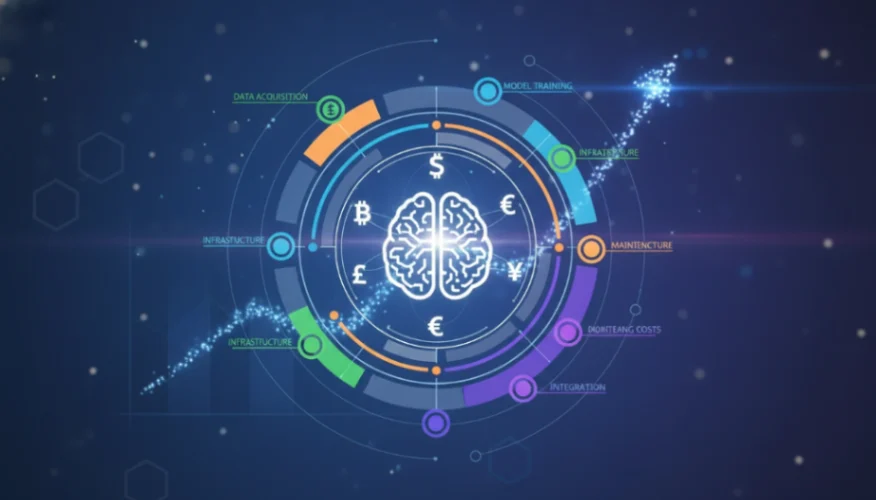
Beyond model licensing, businesses should also consider infrastructure, training, integration, compliance, and maintenance expenses, all of which can significantly impact the total cost of AI agent ownership over time.
Custom AI Agents vs Pre-Built Solutions
One of the most important decisions that influences AI agent development costs is whether to build a custom solution or deploy a pre-built AI platform. Each approach offers distinct advantages, limitations, and pricing implications.
Pre-Built AI Agent Solutions
Pre-built AI agents are typically delivered through SaaS platforms or AI service providers. These solutions offer predefined functionality and faster deployment timelines.
Businesses can often launch pre-built agents within days or weeks rather than months. Initial costs are usually lower because organizations avoid extensive development work.
However, pre-built solutions may limit customization, integration flexibility, and competitive differentiation. As business requirements evolve, subscription fees and platform limitations can become significant considerations.
Custom AI Agent Development
Custom AI agents are built specifically for an organization’s workflows, objectives, and technology ecosystem. While development costs are higher upfront, custom solutions often deliver greater long-term value.
Organizations gain complete control over features, integrations, user experiences, security controls, and scalability strategies.
For example, a financial services company may require an AI agent that integrates with proprietary risk management systems, regulatory databases, and internal compliance workflows. Such requirements are difficult to address using generic platforms.
Businesses evaluating custom development approaches often review guidance on custom software development before initiating AI projects.
In most enterprise environments, custom AI agents become the preferred option when operational complexity and strategic differentiation are priorities.
Infrastructure and Cloud Computing Expenses
Infrastructure represents one of the most significant ongoing costs associated with AI agent deployment. Even organizations using third-party AI models require robust computing environments to support integrations, workflows, monitoring, and data processing.
Cloud Infrastructure Costs
Cloud platforms provide scalability, flexibility, and global availability. However, usage costs can increase significantly as AI agent adoption grows.
Organizations typically incur charges for compute resources, storage, networking, database services, and serverless execution environments.
GPU and AI Processing Requirements
Advanced AI workloads often require specialized hardware such as GPUs for model inference, fine-tuning, and large-scale processing.
The cost of running AI-intensive applications increases substantially when high-performance computing resources are required.
Scalability Considerations
An AI agent supporting 100 users has vastly different infrastructure requirements than one serving 100,000 users. Scalability planning plays a critical role in long-term cost forecasting.
Organizations should carefully evaluate expected usage patterns before selecting infrastructure architectures.
Modern AI environments frequently incorporate technologies associated with cloud computing and distributed systems to support enterprise-scale deployments.
Data Collection, Training, and Fine-Tuning Costs
Data is the foundation of every successful AI agent. The quality, availability, and structure of data directly influence agent performance and overall project costs.
Data Collection
Many organizations underestimate the effort required to gather and prepare data. Information often exists across multiple systems, formats, and departments.
Collecting, cleaning, validating, and organizing datasets can consume a substantial portion of project budgets.
Knowledge Base Development
Enterprise AI agents frequently rely on internal knowledge repositories, documentation libraries, policy manuals, and operational guidelines.
Creating and maintaining these knowledge resources requires ongoing investment.
Fine-Tuning AI Models
While many organizations use foundation models directly, some choose to fine-tune models using proprietary data to improve performance.
Fine-tuning can significantly enhance accuracy and domain-specific expertise but introduces additional training costs.
Data Governance and Quality Management
Organizations must continuously maintain data quality standards to ensure AI agents produce reliable outcomes.
This often involves investments in governance frameworks, auditing procedures, and monitoring systems.
Businesses implementing advanced AI initiatives frequently leverage principles associated with data management to maintain long-term performance and compliance.
Integration and API Development Costs
Most AI agents do not operate independently. They generate the greatest value when connected to existing business systems.
CRM Integrations
Sales and customer support agents often require integrations with customer relationship management platforms to access customer records, interaction histories, and sales opportunities.
ERP Integrations
Enterprise resource planning systems provide access to financial data, procurement workflows, inventory management processes, and operational metrics.
Connecting AI agents to these systems increases implementation complexity.
Third-Party API Connections
Organizations frequently integrate AI agents with external services, payment processors, analytics platforms, communication tools, and industry-specific software solutions.
Each integration requires development, testing, monitoring, and maintenance.
Custom API Development
Some organizations must create custom APIs to enable communication between legacy systems and AI applications.
These efforts contribute significantly to overall project costs but often unlock substantial operational value.
Businesses designing scalable integration strategies frequently reference best practices in software architecture design.
Security, Compliance, and Maintenance Expenses
Security and compliance requirements represent a major cost category, particularly for organizations operating in regulated industries.
Security Controls
AI agents often access sensitive customer information, financial records, operational data, and intellectual property.
Organizations must implement authentication systems, encryption mechanisms, access controls, and monitoring capabilities.
Security strategies frequently align with established principles of computer security.
Regulatory Compliance
Industries such as healthcare, banking, insurance, and government operate under strict regulatory frameworks.
Compliance requirements can significantly increase development, testing, and auditing costs.
Areas such as privacy and data protection require ongoing attention throughout the AI lifecycle.
Maintenance and Optimization
AI agents are not one-time projects. Continuous monitoring, performance optimization, model updates, infrastructure management, and feature enhancements are necessary to maintain effectiveness.
Most organizations allocate annual maintenance budgets equivalent to 15–25% of the original development investment.
Performance Monitoring
Monitoring systems help organizations identify performance issues, security risks, and operational inefficiencies before they affect users.
Continuous optimization ensures AI agents remain aligned with evolving business objectives.
Enterprise AI Agent Cost Estimates by Complexity
AI agent pricing varies considerably based on project scope and technical requirements. While actual costs differ by vendor and region, the following estimates provide a general benchmark.
Basic AI Agents
Simple AI agents designed for FAQ automation, basic customer support, or straightforward workflow execution typically range from $5,000 to $25,000.
These solutions often leverage existing AI platforms and require limited customization.
Mid-Level AI Agents
Agents that include CRM integrations, workflow automation, reporting capabilities, and moderate customization generally cost between $25,000 and $100,000.
Most small and medium-sized businesses fall into this category.
Enterprise AI Agents
Advanced enterprise agents capable of multi-system orchestration, autonomous decision-making, complex workflows, and extensive integrations often range from $100,000 to $500,000 or more.
These projects frequently require dedicated development teams, governance frameworks, and long-term support models.
Highly Specialized AI Platforms
Large-scale enterprise AI ecosystems involving multiple agents, proprietary models, advanced analytics, and global deployments can exceed seven-figure investments.
Such projects often incorporate technologies related to artificial intelligence, predictive analytics, and enterprise automation.
Hidden Costs Businesses Should Consider
Many organizations budget for development expenses but overlook hidden costs that emerge after deployment.
User Training and Adoption
Employees require training to work effectively alongside AI systems. Adoption programs, documentation, and change management initiatives often represent substantial investments.
Workflow Redesign
Implementing AI frequently requires modifying existing business processes. Workflow redesign activities can increase project costs but are often necessary to maximize value.
Vendor Dependency
Organizations relying heavily on external AI providers may encounter increasing usage fees, platform limitations, or vendor lock-in challenges over time.
Scaling Costs
As adoption grows, infrastructure, licensing, storage, and support costs often increase significantly.
Model Upgrades
AI technologies evolve rapidly. Organizations may need periodic upgrades to maintain competitive performance and user expectations.
Businesses evaluating long-term investment strategies often compare AI projects to other digital transformation initiatives discussed by leading AI Agent development companies.
Understanding these hidden costs helps organizations create more accurate budgets and avoid unexpected financial surprises after deployment.
Factors That Affect Long-Term ROI
While initial development costs often receive the most attention, long-term return on investment ultimately determines whether an AI agent project delivers meaningful business value. Organizations that evaluate ROI solely based on implementation expenses frequently overlook the broader financial impact of AI-driven automation.
Operational Efficiency Gains
One of the strongest drivers of AI ROI is operational efficiency. AI agents can automate repetitive tasks, reduce manual workloads, accelerate workflows, and minimize processing delays.
For example, an AI-powered customer support agent can handle thousands of inquiries simultaneously, reducing staffing requirements while improving response times.
Employee Productivity Improvements
By automating administrative responsibilities, AI agents allow employees to focus on strategic initiatives, customer engagement, and innovation.
Productivity gains often generate long-term value that exceeds the original implementation investment.
Customer Experience Enhancements
Faster response times, personalized interactions, and continuous availability contribute directly to customer satisfaction and retention.
Businesses that improve customer experiences frequently see increased revenue and stronger brand loyalty.
Scalability Benefits
Unlike traditional workforce expansion, AI agents can scale rapidly without proportional increases in operational costs.
This scalability becomes particularly valuable for organizations experiencing rapid growth.
Data-Driven Decision-Making
Organizations leveraging AI agents often benefit from improved visibility into business operations and customer behavior.
Enhanced decision-making capabilities create long-term competitive advantages that contribute significantly to ROI.
Companies exploring intelligent business transformation frequently study examples of artificial intelligence real-world applications to understand measurable business outcomes.
How to Reduce AI Development Costs Without Sacrificing Quality
Reducing AI development costs does not necessarily require compromising functionality, performance, or scalability. Strategic planning and technology selection can significantly improve cost efficiency.
Start with a Minimum Viable AI Agent
Rather than building every feature at launch, organizations should prioritize core functionality and expand capabilities over time.
This approach reduces initial investment while allowing businesses to validate assumptions and gather user feedback.
Leverage Existing AI Models
Using established foundation models often eliminates the need for expensive custom model training.
Businesses can focus resources on workflow design, integrations, and user experience improvements.
Prioritize High-Value Use Cases
Organizations should identify areas where AI can generate measurable business impact quickly.
Targeting high-value use cases helps accelerate ROI and justify future investments.
Adopt Cloud-Based Infrastructure
Cloud services allow organizations to scale resources based on demand rather than investing heavily in on-premise infrastructure.
Modern platforms leveraging cloud computing provide flexible pricing models that align with business growth.
Implement Strong Architecture from the Beginning
Poor architectural decisions often create expensive technical debt. Investing in scalable design principles early helps reduce future maintenance and redevelopment costs.
Organizations frequently apply recommendations from software architecture best practices when planning enterprise AI projects.
Build In-House vs Hire an AI Agent Development Company
One of the most significant strategic decisions organizations face is whether to build AI capabilities internally or partner with a specialized development company.
Building In-House
An internal development team provides greater control over intellectual property, product direction, and technical decisions.
However, building an in-house AI team requires substantial investment in recruitment, training, infrastructure, tools, and ongoing talent retention.
Organizations often need AI engineers, machine learning specialists, software developers, data engineers, UX designers, DevOps professionals, and security experts.
Hiring an AI Agent Development Company
Partnering with a specialized development company provides immediate access to experienced professionals, proven methodologies, and established implementation frameworks.
This approach often accelerates project timelines while reducing recruitment and operational challenges.
Businesses evaluating external partners frequently review leading software development companies and specialized AI providers before making decisions.
Cost Comparison
For many organizations, especially startups and mid-sized businesses, partnering with an experienced development company can be more cost-effective than building a complete internal AI team.
Enterprise organizations with ongoing AI initiatives may choose hybrid models that combine internal leadership with external expertise.
Businesses exploring implementation strategies often compare options offered by established software development partners for business before selecting a long-term approach.
Future Trends Impacting AI Agent Costs
The AI landscape is evolving rapidly, and several emerging trends are expected to influence development costs over the coming years.
Lower Foundation Model Costs
Competition among AI providers is driving improvements in efficiency and reducing inference costs.
As AI models become more accessible, businesses may benefit from lower licensing expenses.
Growth of Open-Source AI
Open-source AI ecosystems continue to mature, providing organizations with more alternatives to proprietary platforms.
This trend may reduce dependence on expensive commercial solutions.
Agentic AI Platforms
New platforms designed specifically for autonomous AI agents are simplifying development processes and reducing implementation complexity.
Businesses can increasingly assemble sophisticated AI workflows using reusable frameworks rather than building everything from scratch.
Improved Automation Tools
Advances in development automation are reducing engineering effort required for integration, deployment, testing, and monitoring.
Organizations leveraging technologies such as artificial intelligence, large language models, machine learning, natural language processing, and knowledge graphs are expected to benefit from increasing efficiencies over time.
Industry-Specific AI Solutions
Specialized AI platforms tailored to healthcare, finance, manufacturing, and retail are reducing customization requirements and accelerating deployment timelines.
As these solutions mature, implementation costs for many organizations may decrease significantly.
Conclusion
AI agent development costs vary widely depending on project scope, technical complexity, integrations, infrastructure requirements, compliance obligations, and long-term operational needs. While basic AI agents may be deployed for a relatively modest investment, enterprise-grade autonomous systems often require substantial resources and strategic planning.
Organizations that understand the full cost structure of AI projects are better positioned to make informed investment decisions, avoid unexpected expenses, and maximize return on investment. Beyond development costs, businesses must account for infrastructure, security, maintenance, data management, and ongoing optimization requirements.
The most successful AI initiatives are not necessarily the most expensive. They are the ones that align technology investments with business objectives, prioritize measurable outcomes, and implement scalable architectures from the beginning.
As AI technologies continue to evolve, development costs are expected to become more accessible while capabilities become increasingly sophisticated. Businesses that begin exploring AI agent opportunities today will be better prepared to capitalize on future advancements and maintain a competitive advantage in an increasingly automated marketplace.
Looking for expert guidance on AI implementation? Contact us and work with a trusted AI development partner to build intelligent AI agents that automate workflows, enhance productivity, and accelerate digital transformation across your organization.
Frequently Asked Questions (FAQs)
How much does it cost to develop an AI agent?
The cost of developing an AI agent can range from $5,000 for a basic chatbot or workflow assistant to more than $500,000 for a sophisticated enterprise-grade autonomous AI solution. The final cost depends on factors such as functionality, integrations, AI model selection, infrastructure requirements, customization, and security needs.
What is the biggest cost factor in AI agent development?
The biggest cost drivers typically include AI model licensing, custom development efforts, system integrations, cloud infrastructure, data preparation, and ongoing maintenance. Enterprise projects often require additional investments in compliance, governance, and advanced security measures.
Are custom AI agents more expensive than pre-built solutions?
Yes, custom AI agents generally involve higher upfront development costs because they are designed specifically around an organization’s business processes and requirements. However, they often provide greater flexibility, scalability, competitive differentiation, and long-term value compared to pre-built solutions.
What ongoing costs should businesses expect after deployment?
Businesses should budget for cloud hosting, AI model usage fees, infrastructure scaling, software updates, security monitoring, maintenance, performance optimization, and support services. These recurring expenses are essential for ensuring long-term reliability and effectiveness.
Is it cheaper to build an AI agent in-house or hire an AI development company?
The answer depends on the organization’s resources, expertise, and long-term objectives. Building an AI agent in-house requires recruiting and managing specialized talent, while hiring an AI development company provides immediate access to experienced professionals and established processes. For many businesses, partnering with an experienced AI development company can reduce risk and accelerate deployment while controlling costs.