

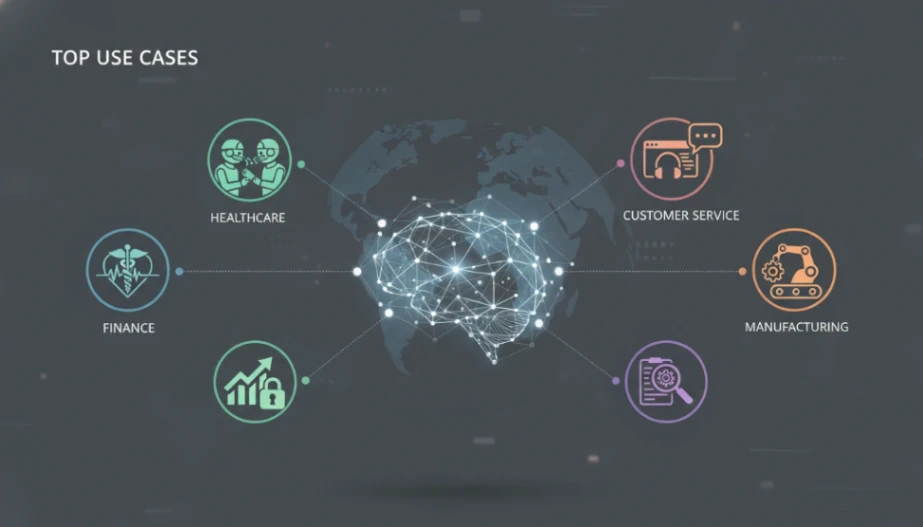
Artificial intelligence is no longer limited to chatbots or predictive analytics tools. Modern businesses are increasingly deploying AI agents that can reason, make decisions, automate workflows, interact with multiple systems, and continuously improve performance through learning. As organizations pursue digital transformation initiatives, AI agents are becoming a critical component of operational strategy, driving demand for experienced AI agent development company partners that can design and deploy enterprise-grade intelligent solutions.
Unlike traditional automation systems that follow predefined rules, AI agents can understand context, analyze data, and execute tasks autonomously. From healthcare providers and financial institutions to manufacturers and retailers, businesses across sectors are implementing intelligent agents to streamline operations and enhance customer experiences. A trusted AI agent development company helps organizations build customized solutions that align with specific business goals, workflows, and operational requirements.
Organizations exploring enterprise AI adoption often begin by understanding artificial intelligence and how it can be applied to real-world business challenges. Working with an AI agent development company enables businesses to identify high-impact use cases, select the right technologies, and create scalable AI strategies that deliver measurable results.
The rapid growth of AI technologies has created new opportunities for organizations to reduce costs, improve efficiency, and create competitive advantages. As AI capabilities continue to evolve, intelligent agents are emerging as one of the most impactful applications of modern enterprise technology. Businesses that collaborate with a skilled AI agent development company are better positioned to accelerate innovation, automate complex processes, and achieve long-term digital transformation success.
What are AI Agents and How Do They Work?
AI agents are intelligent software systems designed to perform tasks, make decisions, and interact with users or other systems with varying levels of autonomy. These agents combine technologies such as artificial intelligence, machine learning, natural language understanding, reasoning engines, and workflow orchestration frameworks.
An AI agent typically receives input, processes information, evaluates potential actions, and executes the most appropriate response. Depending on its design, an agent may access enterprise databases, communicate with external applications, retrieve knowledge from internal repositories, or collaborate with other AI agents.
Modern AI systems are increasingly powered by natural language processing, enabling human-like interactions and contextual understanding.
Businesses interested in understanding foundational AI concepts often explore different types of artificial intelligence to understand how intelligent systems are evolving across industries.
Why Industries are Adopting AI Agents
Organizations face constant pressure to improve productivity, reduce operational costs, enhance customer experiences, and respond more quickly to changing market conditions. AI agents help address these challenges by automating repetitive processes while enabling intelligent decision-making.
Unlike conventional software solutions, AI agents can adapt to changing conditions, learn from interactions, and optimize workflows over time. This makes them particularly valuable in industries with large volumes of data, complex operations, and customer-facing processes.
Companies adopting AI agents often report improvements in response times, operational efficiency, resource utilization, and customer satisfaction. Many enterprises studying artificial intelligence real-world applications identify intelligent agents as one of the highest-impact use cases.
The growing accessibility of cloud infrastructure, AI frameworks, and enterprise integrations has accelerated adoption across organizations of all sizes.
AI Agents in Healthcare
AI Agents in healthcare sector generates vast amounts of patient information, medical records, diagnostic reports, and operational data. AI agents help healthcare providers manage this complexity while improving patient outcomes and administrative efficiency.
Healthcare organizations use AI agents for appointment scheduling, patient communication, medical documentation, claims management, and clinical decision support. Intelligent assistants can help physicians access relevant patient information quickly and reduce administrative workloads.
Advanced healthcare agents leverage medical diagnosis support systems and predictive analytics to identify potential health risks and recommend preventive interventions.
Organizations investing in healthcare technology often review healthcare software development companies to understand how intelligent healthcare solutions are being implemented.
AI agents also improve operational efficiency by automating insurance verification, patient follow-ups, and compliance-related workflows.
AI Agents in Banking and Financial Services
Financial institutions are among the earliest adopters of AI-driven automation. Banks, fintech firms, and investment organizations use AI agents to improve customer experiences while strengthening risk management and operational efficiency.
AI agents for finance and banking can assist with fraud detection, loan processing, compliance monitoring, portfolio analysis, customer support, and financial planning. By analyzing large volumes of transactional data, these systems can identify unusual patterns and potential risks in real time.
Many financial organizations leverage financial technology innovations to create intelligent customer engagement systems capable of delivering personalized recommendations.
Businesses evaluating AI adoption in finance frequently explore fintech software development company operations to understand how intelligent automation supports modern financial services.
AI agents are increasingly being used to automate regulatory reporting, customer onboarding, and anti-money laundering procedures.
AI Agents in Retail and E-Commerce
Retailers operate in highly competitive environments where customer experience, inventory management, and personalized engagement directly influence revenue. AI agents help businesses optimize these areas through intelligent automation.
Retail AI agents can provide product recommendations, manage customer inquiries, monitor inventory levels, forecast demand, and automate marketing campaigns. These capabilities enable retailers to deliver highly personalized shopping experiences while improving operational efficiency.
Many e-commerce platforms utilize recommendation systems powered by AI agents to increase conversion rates and customer retention.
AI-driven retail operations also support dynamic pricing strategies, abandoned cart recovery, and supply chain visibility. Intelligent agents can continuously analyze customer behavior and adapt promotional strategies accordingly.
The ability to combine automation with personalized engagement makes AI agents particularly valuable in modern retail environments.
AI Agents in Manufacturing and Industry 4.0
Manufacturing organizations are embracing AI agents as part of broader Industry 4.0 initiatives focused on intelligent automation, operational visibility, and predictive maintenance.
AI agents for manufacturing monitor production systems, analyze machine performance, detect anomalies, and recommend maintenance activities before equipment failures occur. This helps manufacturers reduce downtime and improve operational efficiency.
Advanced manufacturing systems leverage automation technologies and industrial robots coordinated through intelligent agent frameworks.
Organizations implementing custom enterprise systems often explore custom software development approaches to create AI-powered manufacturing solutions tailored to specific operational requirements.
AI agents also improve quality control by identifying defects, monitoring production consistency, and supporting real-time decision-making across manufacturing environments.
As Industry 4.0 continues to evolve, intelligent agents are becoming central to smart factories, connected operations, and autonomous production ecosystems.
AI Agents in Logistics and Supply Chain Management
AI Agents for Logistics and supply chain have become increasingly complex due to globalization, fluctuating demand, and evolving customer expectations. AI agents help organizations gain real-time visibility into logistics operations while optimizing planning and execution.
These intelligent systems can forecast demand, monitor shipments, optimize delivery routes, identify disruptions, and recommend corrective actions. By continuously analyzing operational data, AI agents help businesses improve supply chain resilience and efficiency.
Modern logistics solutions frequently utilize predictive analytics to anticipate delays and reduce operational risks.
AI agents can also automate supplier communications, warehouse management activities, inventory replenishment, and transportation planning. This reduces manual intervention while improving decision-making accuracy.
As organizations pursue digital supply chain transformation, AI agents are becoming essential tools for enhancing agility and operational performance.
AI Agents in Insurance and Claims Processing
Insurance providers handle large volumes of policy applications, customer inquiries, claims submissions, and compliance-related documentation. AI agents for insurance help streamline these processes while improving service quality.
Claims processing agents can analyze documentation, verify information, identify potential fraud indicators, and accelerate approval workflows. This significantly reduces processing times and operational costs.
AI-powered systems also support risk assessment, underwriting assistance, policy recommendations, and customer service automation.
By automating repetitive administrative tasks, insurance professionals can focus on complex customer interactions and strategic decision-making.
The combination of automation and intelligent decision support enables insurers to improve customer experiences while maintaining regulatory compliance.
AI Agents in Education and EdTech
Educational institutions and EdTech providers are increasingly using AI agents for education to personalize learning experiences and improve administrative efficiency.
AI tutors can adapt learning pathways based on student performance, identify knowledge gaps, and recommend targeted educational resources. This creates more personalized and effective learning experiences.
Educational organizations are also using AI agents for admissions support, student engagement, attendance tracking, content generation, and academic advising.
Intelligent educational systems often leverage education technology platforms to deliver scalable and adaptive learning experiences.
By automating administrative tasks and supporting individualized learning, AI agents help institutions improve outcomes for both educators and students.
AI Agents in Real Estate
Real estate professionals manage extensive property information, client interactions, documentation, and market analysis activities. AI agents help automate these processes while improving decision-making.
Real estate AI agents can assist with property recommendations, lead qualification, appointment scheduling, document management, and customer communications.
Intelligent systems also analyze market trends, property valuations, investment opportunities, and buyer preferences to support informed decision-making.
AI-powered virtual assistants help prospective buyers and tenants find relevant properties more efficiently while reducing manual workload for agents.
As digital transformation continues across the property sector, AI agents are helping organizations deliver more responsive and data-driven services.
AI Agents in Telecommunications
Telecommunications providers manage vast customer bases, complex infrastructure networks, and high volumes of support requests. AI agents help optimize both customer-facing and operational activities.
Network monitoring agents continuously analyze system performance, identify potential outages, and recommend corrective actions before service disruptions occur.
Customer support agents assist subscribers with billing inquiries, technical troubleshooting, service upgrades, and account management.
Advanced telecom systems frequently incorporate automated operations to improve network reliability and service quality.
By combining operational intelligence with customer service automation, AI agents help telecommunications providers improve efficiency and customer satisfaction.
AI Agents in Human Resources and Recruitment
AI Agents for Human resources teams manage recruiting, onboarding, employee engagement, performance management, and workforce planning activities. AI agents help automate these processes while improving decision quality.
Recruitment agents can screen resumes, evaluate candidate qualifications, schedule interviews, and answer applicant questions. This significantly reduces administrative workload for HR professionals.
AI-powered workforce analytics also support talent planning, employee retention strategies, and organizational development initiatives.
Many organizations use intelligent agents to automate onboarding processes, training recommendations, and employee support services.
As businesses compete for talent, AI-driven HR solutions help improve recruitment efficiency and employee experiences.
AI Agents in Customer Support and Service Automation
AI Agents for Customer support remains one of the most widely adopted use cases for AI agents. Businesses across industries use intelligent assistants to manage customer interactions, resolve issues, and provide 24/7 service availability.
Modern support agents can understand customer intent, retrieve relevant information, execute workflows, and escalate complex issues when necessary.
Organizations implementing conversational AI frequently explore chatbot development company for business solutions as part of broader customer service transformation initiatives.
AI agents help reduce response times, improve service consistency, and lower support costs while maintaining high levels of customer satisfaction.
The ability to provide instant, personalized assistance makes AI agents valuable across virtually every customer-facing industry.
AI Agents for Sales and Marketing Operations
Sales and marketing teams rely on data-driven insights, customer engagement, and campaign optimization to drive growth. AI agents help automate these activities while improving performance.
Marketing agents can analyze customer behavior, segment audiences, personalize content, optimize campaigns, and recommend strategic actions.
Sales agents assist with lead qualification, opportunity scoring, customer outreach, meeting scheduling, and pipeline management.
Organizations increasingly use customer relationship management platforms integrated with AI agents to improve sales productivity and forecasting accuracy.
By combining automation with intelligent decision support, businesses can accelerate revenue generation while improving customer engagement.
Benefits of AI Agents Across Industries
AI agents deliver significant benefits regardless of industry. Organizations implementing intelligent automation typically experience increased productivity, reduced operational costs, improved decision-making, and enhanced customer experiences.
These systems can operate continuously, process large volumes of information, and adapt to changing conditions more effectively than traditional automation solutions.
Businesses exploring enterprise AI initiatives often evaluate AI development companies to identify implementation partners capable of delivering scalable solutions.
Additional benefits include improved scalability, faster response times, greater operational visibility, and more efficient resource utilization.
Challenges and Industry-Specific Considerations
Despite their advantages, AI agents present several implementation challenges. Organizations must address data quality issues, integration complexity, governance requirements, security concerns, and regulatory compliance obligations.
Industries such as healthcare, banking, and insurance often face stricter regulatory requirements that influence AI deployment strategies.
Successful implementations require clear objectives, strong governance frameworks, stakeholder alignment, and ongoing monitoring.
Organizations evaluating implementation approaches frequently review how to find a software development company for business to ensure long-term project success.
Addressing these challenges proactively helps maximize AI adoption outcomes while minimizing operational risks.
Future Trends in Industry-Specific AI Agents
The future of AI agents will be shaped by advancements in autonomous decision-making, multi-agent collaboration, real-time analytics, and enterprise orchestration.
Organizations are increasingly exploring systems powered by large language models that can coordinate multiple workflows and interact across diverse business systems.
Future AI agents will become more specialized, industry-aware, and capable of handling increasingly complex tasks with minimal human intervention.
Businesses evaluating long-term AI strategies often benefit from understanding machine learning fundamentals and evolving intelligent automation capabilities.
As AI technologies mature, industry-specific agents will play an increasingly important role in operational transformation and competitive differentiation.
Conclusion
AI agents are rapidly reshaping industries by automating workflows, enhancing decision-making, improving customer experiences, and enabling organizations to operate more efficiently. From healthcare and finance to manufacturing, logistics, education, and telecommunications, intelligent agents are becoming a foundational component of digital transformation strategies.
The ability of AI agents to understand context, process information, and execute actions autonomously makes them one of the most valuable applications of modern artificial intelligence. Organizations that successfully implement these technologies can achieve significant improvements in productivity, agility, and business performance.
Whether your goal is to automate customer support, optimize operations, improve workforce productivity, or create personalized user experiences, AI agents offer substantial opportunities for innovation and growth.
Looking for expert guidance on AI implementation? Contact us and work with a trusted AI development partner to build intelligent AI agents that automate workflows, enhance productivity, and accelerate digital transformation across your organization.
Frequently Asked Questions (FAQs)
What are the most common use cases of AI agents across industries?
AI agents are commonly used for customer support automation, predictive analytics, workflow automation, fraud detection, supply chain optimization, employee assistance, sales enablement, and personalized customer experiences. Their versatility allows businesses across healthcare, finance, retail, manufacturing, and education to improve efficiency and decision-making.
How do AI agents differ from traditional automation tools?
Traditional automation follows predefined rules and workflows, whereas AI agents can understand context, learn from data, make decisions, and adapt to changing conditions. This enables them to handle more complex tasks and deliver greater business value than conventional automation systems.
Which industries are seeing the fastest adoption of AI agents?
Healthcare, banking, financial services, retail, e-commerce, manufacturing, logistics, telecommunications, and customer service sectors are among the fastest adopters of AI agents. These industries benefit from improved operational efficiency, enhanced customer experiences, and data-driven decision-making.
Can AI agents integrate with existing enterprise systems?
Yes, modern AI agents can integrate with CRM platforms, ERP systems, databases, cloud applications, communication tools, and other enterprise software through APIs and middleware solutions. This allows businesses to automate workflows without replacing their existing technology infrastructure.
What are the key benefits of implementing AI agents in business operations?
AI agents help organizations reduce operational costs, increase productivity, improve customer satisfaction, automate repetitive tasks, accelerate decision-making, and scale operations more effectively. They also provide valuable insights from large volumes of data, enabling businesses to respond faster to market changes and opportunities.