


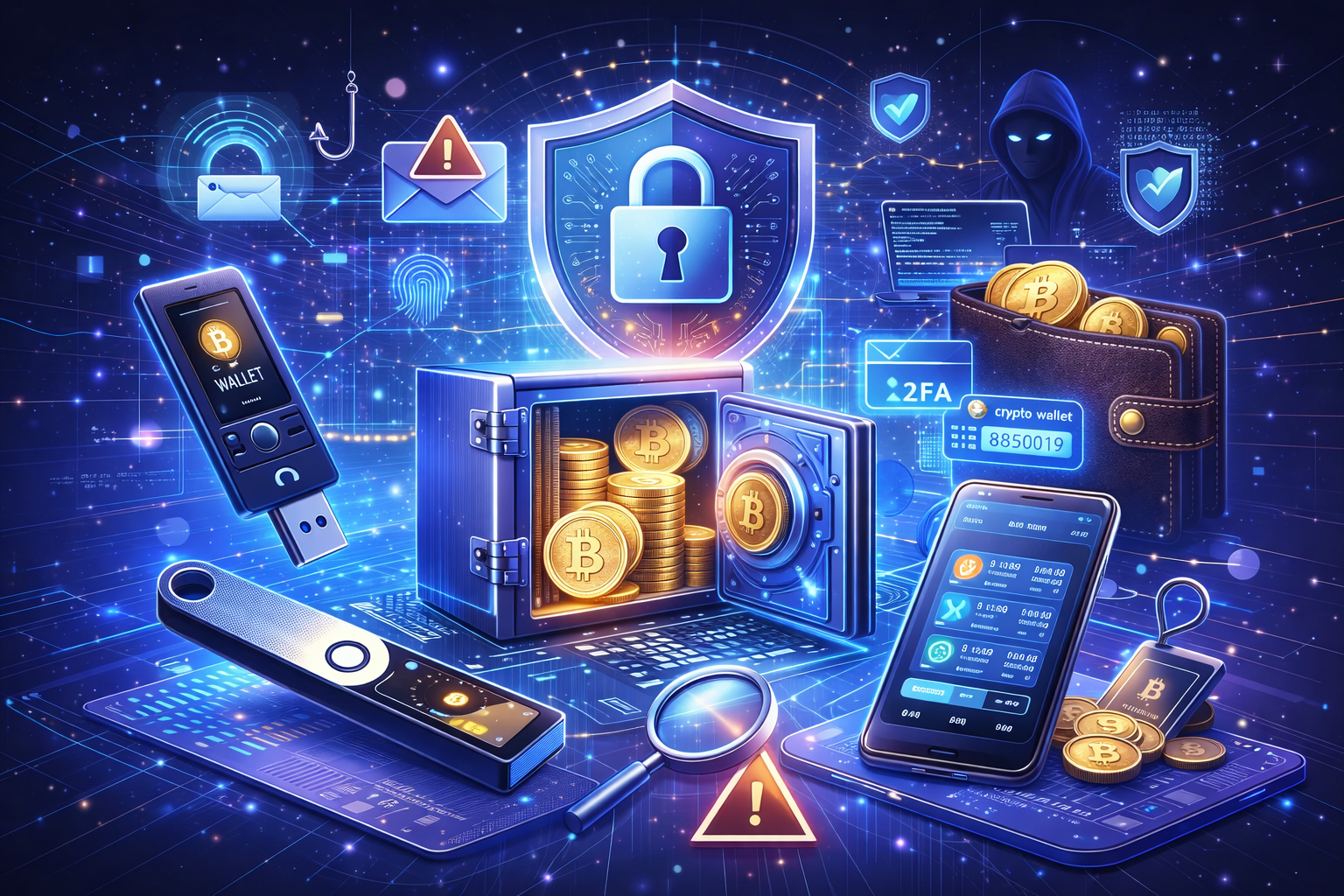
Introduction
The digital asset landscape has evolved from a niche experimental playground into a cornerstone of the modern financial ecosystem. As of early 2026, the complexity of the market has grown in tandem with its valuation, bringing both unprecedented opportunities and sophisticated threats. For any investor, the priority is no longer just “which coin to buy,” but “how to keep it.”
Securing cryptocurrency is fundamentally different from traditional banking. In the world of decentralized finance, you are your own bank. This sovereignty offers freedom, but it shifts the entire burden of security onto the individual or the enterprise. A single mistake—a lost password, a clicked phishing link, or an unencrypted seed phrase—can result in the permanent loss of assets with no “forgot password” button or customer support to call for a reversal.
Understanding the mechanics of secure cryptocurrency storage is the first step toward long-term financial safety. This guide explores the diverse world of wallet types, the rising tide of security risks in 2026, and the best practices required to protect your digital wealth.
The Foundation: Understanding Private Keys
Before diving into wallet types, one must understand the core of crypto security: the private key.
A cryptocurrency wallet does not actually “store” your coins in the way a physical wallet holds cash. Instead, the coins live on the blockchain. The wallet stores the private key—a sophisticated cryptographic string that allows you to access and move those coins. If the private key is the “key” to a digital vault, the public address is the “mailbox” where others can send you funds.
Private key management is the alpha and omega of crypto safety. If you own your private keys (self-custody), you own your money. If a third party—like an exchange—holds them for you (custodial), you are essentially holding a “promise” of payment, much like a traditional bank account.
Why Your Key is Your Identity
In 2026, the concept of “identity is the new perimeter” has become a central theme in cybersecurity. Your private key isn’t just a password; it is a mathematical proof of ownership. As AI-driven attacks become more prevalent, the ability to protect this proof of identity is what separates a secure portfolio from a compromised one.
Hot Wallets vs. Cold Wallets: Finding the Balance
The most common categorization of crypto storage is the distinction between “hot” and “cold” wallets. The difference lies in one primary factor: connectivity to the internet.
1. Hot Wallets (Online Storage)
Hot wallets are applications that run on internet-connected devices like smartphones, tablets, or computers. They are designed for convenience, allowing users to trade, swap, or spend crypto quickly.
- Software Wallets: Apps like MetaMask, Trust Wallet, or Coinbase Wallet.
- Web/Browser Wallets: Extensions that interact directly with decentralized applications (dApps).
- Exchange Wallets: Custodial accounts where the platform manages the keys on your behalf.
Pros: High accessibility, usually free, and perfect for frequent traders or interacting with DeFi.
Cons: Highly vulnerable to malware, phishing, and remote hacks because the private keys are stored on a device that touches the internet.
2. Cold Wallets (Offline Storage)
Cold wallets are physical devices or methods that keep private keys entirely offline. Because they never “touch” the internet, they are virtually immune to remote hacking attempts.
- Hardware Wallets: Specialized USB-like devices (e.g., Ledger, Trezor) that sign transactions internally without ever exposing the private key to the computer.
- Paper Wallets: Printing your private key and public address on a physical piece of paper and storing it in a safe.
- Air-Gapped Computers: Using a computer that has never been connected to the internet to generate and store keys.
Pros: Maximum security against cyberattacks; ideal for “HODLing” large amounts.
Cons: Less convenient for daily use; requires physical protection of the device and recovery seed.
Also read: Hot Wallet Vs Cold Crypto Wallets
3. The Hybrid Approach
Many investors now use a “Tiered Storage” model. They keep 5-10% of their holdings in a hot wallet for active trading and 90-95% in a cold wallet for long-term safety. This minimizes the “blast radius” if a hot wallet is compromised.
Also read: Types of Crypto Wallets: Hot & Cold Explained
The Rising Stakes: Crypto Security Risks in 2026
The necessity for robust security is underscored by the alarming rise in sophisticated cybercrime. As adoption has scaled, so has the “industrialization” of fraud.
Reputable Reports and Statistics
- The Chainalysis 2026 Crypto Crime Report highlights that in 2025, incidents of crypto theft rose sharply to $3.4 billion, a reminder that relying on human intervention alone is increasingly inadequate.
- The World Economic Forum’s Global Cybersecurity Outlook 2026 notes that 94% of security leaders anticipate AI to be the most significant driver of change in the cyber landscape, enabling hyper-realistic phishing and automated “pig butchering” scams that are 4.5x more profitable than traditional methods.
Also read: Crypto Development Security Best Practices | Secure Blockchain Solutions
Common Threats to Your Assets in 2026
- Deepfake Phishing: Attackers use AI-driven voice cloning and deepfake video to impersonate exchange CEOs or IT support to trick users into revealing sensitive data.
- Address Poisoning: Attackers send tiny amounts of crypto to your wallet from an address that looks almost identical to your own, hoping you’ll copy it from your history for a future transfer.
- Malicious Smart Contracts: Connecting your wallet to a “scam” DeFi site that asks for permission to “spend” your tokens, only to drain your balance instantly.
- SIM Swapping: Hackers take over your phone number to bypass SMS-based two-factor authentication (2FA).
Crypto Wallet Security Best Practices
To stay ahead of these threats, investors must adopt a layered defense strategy. Whether you are an individual or looking to consult a Cryptocurrency Development Company to build a secure enterprise solution, the following best practices are non-negotiable.
1. The “Golden Rule” of Seed Phrases
Your seed phrase (usually 12 or 24 words) is the master key to your wallet.
- Never store it digitally (No photos, no Cloud storage, no emails).
- Never type it into a website unless you are restoring your wallet on official software.
- Always write it down on physical media—ideally a stainless steel backup plate that is fireproof and waterproof—and store it in a secure, hidden location.
2. Physical Security: The “Wrench Attack”
In 2026, as crypto prices have reached new highs, physical coercion has become a documented risk. To mitigate this:
- Plausible Deniability: Use hardware wallets that allow a “decoy” account with a secondary PIN.
- Discretion: Avoid wearing crypto-branded apparel or sharing portfolio sizes on social media.
3. Implement Advanced Multi-Factor Authentication (MFA)
If you use exchange accounts, never rely on SMS 2FA.
- Use app-based authenticators like Google Authenticator or Microsoft Authenticator.
- For the highest security, use physical security keys like YubiKey.
4. Enable “Whitelisting” and Time-Locks
Most major exchanges allow you to “whitelist” withdrawal addresses. This means even if a hacker gains access to your account, they cannot send funds to an unknown address for 24–48 hours, giving you time to react and lock the account.
5. Multi-Signature (Multisig) Wallets
For businesses or high-net-worth individuals, a single private key is a single point of failure. Multisig wallets require two or more private keys to authorize a transaction. For example, a “2-of-3” setup requires two out of three authorized users to sign off, drastically reducing the risk of a single compromised device.
Also read: Crypto Wallet Security Best Practices | Protect Digital Assets
Professional Storage: A Corporate Perspective
As digital assets become a standard part of corporate balance sheets—with institutions like BlackRock and Fidelity now managing tens of billions in spot crypto products—the demand for Cryptocurrency Development Services has shifted toward institutional-grade custody.
The Role of MPC (Multi-Party Computation)
MPC is a cutting-edge technology that eliminates the “single private key” problem without the complexity of traditional multisig. It breaks a private key into multiple “shards” distributed among different parties. The key is never reconstructed in its entirety in any one place.
Firms like Vegavid emphasize the integration of MPC protocols when designing custom Cryptocurrency Development Solutions for their partners. By focusing on the architecture of the wallet itself, they ensure that security is “baked in” from the start rather than added as an afterthought.
AI-Enhanced “Intelligent” Wallets
In 2026, we are seeing the rise of AI wallets that act as personal bankers. These wallets can:
- Detect Fraud Automatically: Scanning transaction patterns to flag risks before a user signs.
- Transaction Simulation: Executing a transaction in a secure sandbox first to show exactly what permissions are being granted.
- Predictive Threat Scoring: Identifying account takeovers before the funds can be moved.
Vegavid is among the forward-thinking companies exploring how AI-driven anomaly detection can replace static “set and forget” security models, providing a dynamic defense against evolving threats.
The Importance of Regular Audits
No system is static. Software updates, new exploit discoveries, and evolving social engineering tactics mean that security must be audited regularly.
- Smart Contract Audits: If you are interacting with DeFi, ensure the protocols have been audited by reputable firms.
- Penetration Testing: For businesses, regular “pentesting” of your storage infrastructure is vital. Companies like Vegavid advocate for these rigorous checks to ensure no hidden backdoors exist in the storage layer.
- Backup Verification: Once a year, “test” your recovery process. Wipe a small hardware wallet and restore it using your seed phrase to ensure you haven’t made a transcription error.
Also read: Audit & Documentation Requirements for Crypto Traders India
Institutional Adoption and the Regulatory “Hardening”
2026 is the year of enforcement. Regulations like MiCA in the EU have moved from planning to active supervision. This means that for many, “security” now also includes “compliance.”
Institutions now oversee roughly 5–7% of all Bitcoin in circulation through ETPs (Exchange Traded Products). This institutionalization has driven the maturity of custody expertise, forcing providers to meet stringent operational standards. Whether you are a solo investor or a firm utilizing Cryptocurrency Development Services, staying aligned with these emerging standards is essential for long-term viability.
Conclusion: Taking Control of Your Digital Future
Securing your cryptocurrency is a continuous process of education and adaptation. The statistics from the Chainalysis and WEF reports serve as a sobering reminder that the “honeypot” for hackers is only growing. However, by separating your funds between hot and cold storage, mastering private key management, and staying vigilant against AI-driven social engineering, you can enjoy the benefits of the digital economy without becoming a statistic.
If you are a business looking to navigate this landscape or require a robust infrastructure for your digital assets, working with an experienced partner like Vegavid can provide the technical edge needed to stay secure.
Are you ready to fortify your digital assets?
Schedule a free consultation with Vegavid today!
Frequently Asked Questions (FAQs)
1. Is it safe to store my crypto on a major exchange like Coinbase or Binance?
While reputable exchanges use advanced security, they are considered “custodial” wallets, meaning you do not own your private keys. In the crypto world, the saying “Not your keys, not your coins” rings true. Exchanges are high-value targets for hackers and can be subject to regulatory freezes or insolvency. For long-term savings, it is always safer to move your assets to a non-custodial cold wallet.
2. What happens if I lose my hardware wallet?
If you lose the physical device, your funds are still safe as long as you have your seed phrase (the 12 or 24 words provided during setup). You can simply purchase a new hardware wallet and “restore” your account using those words. However, if you lose both the device and the seed phrase, your assets are permanently inaccessible.
3. Can I just take a photo of my seed phrase and keep it in my hidden photos?
No. This is one of the most common security mistakes. Hackers use malware to scan devices for images that look like seed phrases or documents containing crypto-related keywords. If your phone is backed up to the Cloud (iCloud/Google Photos), a breach of your email or cloud account would give a thief instant access to your funds. Always keep your seed phrase on physical media, like paper or metal.
4. How often should I update my wallet software or firmware?
You should update your wallet software as soon as a new version is released. Developers frequently push updates to patch newly discovered security vulnerabilities. For hardware wallets, only perform firmware updates through the official manufacturer’s app (e.g., Ledger Live or Trezor Suite) to avoid “fake update” phishing scams.
5. What is the benefit of a “Multisig” wallet for a business?
A Multi-signature (Multisig) wallet requires more than one person to approve a transaction. For example, in a “2-of-3” setup, two different executives must sign off before any funds can leave the account. This prevents a “single point of failure”—if one person’s laptop is hacked or if an employee tries to act maliciously, they cannot move the money alone.
6. Does a Cryptocurrency Development Company help with wallet security?
Yes. A professional Cryptocurrency Development Company focuses on building the underlying architecture of a wallet. This includes implementing features like Multi-Party Computation (MPC), biometric authentication, and secure API integrations to ensure that the platform is resilient against the latest 2026 cyber threats.